
The American Heart Association is a non-profit organization founded in 1924 that was established to educate the community in cardiac care and improve the outcomes of health-related emergencies. The AHA employs hundreds of scientists and healthcare personnel who research, review findings and publish their recordings to promote the most effective treatment methods. They typically update their guidelines every five years to inform the healthcare industry on the results of current research and state-of-the-art treatment.
Since the AHA guidelines directly affect healthcare professionals and the care they provide, all medical personnel are responsible for reading the latest updates issued by the AHA, which can be found in the 2015 American Heart Association Guidelines for CPR & ECC. The updated guidelines are available on the AHA website and can be accessed through a link leading to Circulation, a journal published by the AHA, downloaded as a break down highlighting the main points, or viewed on a mobile-friendly web page.
What are the Primary Changes Included in The Updated AHA Guidelines?
- The rate and depth of chest compressions. Updated AHA guidelines declare that the rate of compressions during CPR should be at least 100 per minute, and more specifically, 100-120 per minute. Previous guidelines recommended giving at least 100 compressions per minute, without emphasizing that there should be an upper limit minute. Also, the depth of compressions should be at least 2 inches for adults and children, without reaching depths greater than 2.4 inches.
- Temperature management during brain trauma emergencies. The updated AHA guidelines for healthcare professionals bring attention to temperature control given during post-cardiac arrest care to prevent brain damage. Updated research suggests healthcare professionals should choose a temperature between 32 degrees Celsius and 36 degrees Celsius and keep that temperature constant throughout the entire treatment and that it needs to be maintained for at least 24 hours.
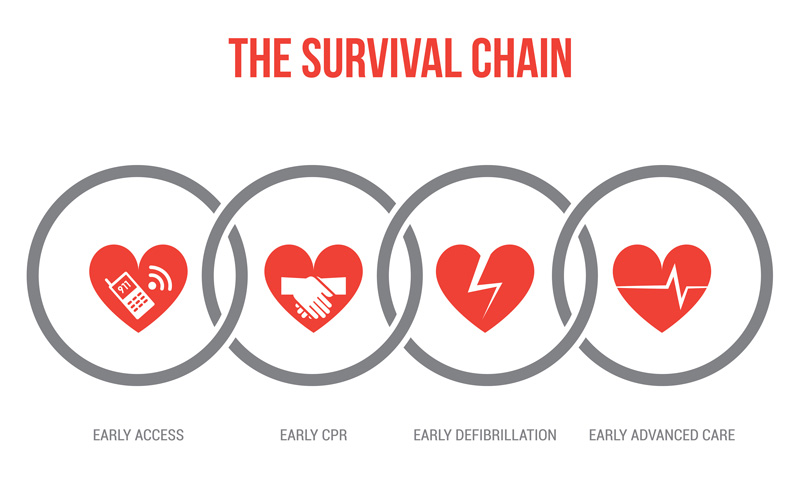
- The Chain of Survival process and timing. The Chain of Survival refers to the actions that should be taken upon immediately responding to an unconscious victim. According to the updated guidelines, the emergency response system should be immediately activated upon arrival to the scene, including the early application of CPR with an emphasis on chest compressions. Also, CPR should be performed simultaneously to reduce any time wasted before beginning CPR, such as checking for a pulse, and ordering another person to call for help.

What Guidelines for Healthcare Professionals Remain the Same?
The 2015 AHA guidelines maintain a strong emphasis on the proven methods of CPR, as well as the quick application of such techniques. Chest compressions and mouth-to-mouth are still recommended for unconscious victims, although, new recommendations now urge rescuers to perform chest compressions as quickly as possible and without interruption from rescue breaths and shocks. New guidelines for healthcare professionals also continue to bring attention to the fact that CPR from a bystander, both professional and non-professional, is vital to the improvement of cardiac arrest survival rates.
In addition to staying updated with current certifications, healthcare professionals are responsible for taking the time to read through the latest AHA guidelines to keep current on the best treatments and their application.