Your California EMT certification is expiring — or maybe it already has. Either way, the clock is running, and a lapsed card means you can’t legally respond to calls until you’re back in compliance.
The renewal process in California isn’t complicated, but it does have specific requirements that vary depending on how long your certification has been expired, which county you’re certifying through, and whether you’re maintaining your NREMT alongside your state card. Getting the details wrong costs you time, money, and in some cases requires you to retake exams you’ve already passed.
This guide covers exactly what California EMTs need to know: what the state requires, how the EMSA and LEMSA system works, where CPR fits in, and the fastest path to getting your certification renewed without disrupting your work.
How California EMT Certification Works: EMSA vs. LEMSA
Before getting into renewal specifics, it’s worth understanding the structure that governs California EMT certification — because this is where many people get confused.
EMSA (the California Emergency Medical Services Authority) sets the statewide rules and standards. But EMSA does not directly certify EMTs or process renewal applications. There is no online process at EMSA for applying for or renewing EMT certification.
That responsibility belongs to LEMSAs — Local EMS Agencies — which operate at the county level. California has 33 LEMSAs, and each one handles its own certification applications, documentation requirements, fees, and processing timelines. Your certification is issued by and renewed through the LEMSA in the county where you hold your certification.
The practical implication: the baseline renewal requirements are set by EMSA under Title 22 of the California Code of Regulations, but your specific forms, fees, and submission process are determined by your LEMSA. Always contact your certifying county EMS agency directly to confirm local requirements before you submit.
Standard EMT Renewal Requirements in California
Assuming your certification is current and you’re renewing before it expires, California requires the following:
1. Continuing Education — 24 Hours
You must complete 24 hours of approved EMS continuing education (CE) within the two-year certification cycle. This requirement can be satisfied in one of two ways:
- 24 hours of approved EMS CE courses from CAPCE-accredited (formerly CECBEMS) providers, EMSA-approved California CE providers, or approved college coursework in relevant fields
- An approved 24-hour EMT refresher course completed within the past two years
Important: Not all CE counts. Board of Registered Nursing courses, AMA courses, and other non-EMS continuing education cannot be used toward your EMT CE requirement. Verify that every course you’re planning to submit is CAPCE- or EMSA-approved before you complete it.
Some LEMSAs — including San Diego County — require that at least half of the 24 CE hours be completed in an instructor-based format covering topics in the U.S. DOT Education Standards. Check with your county.
2. Skills Competency Verification
You must complete the EMT Skills Competency Verification Form (EMSA-SCV 01-17). This form must be signed by an approved verifier — a certified or licensed EMT, AEMT, paramedic, registered nurse, physician assistant, or physician who is designated by an EMSA-approved training program or CE provider, or from an approved ALS service provider within California.
The skills competency verification is what confirms you can still actually perform the hands-on procedures — it’s not just a paperwork exercise. Make sure your verifier’s credentials are current and they qualify under your LEMSA’s specific approval list.
3. Required Specialty Training Documentation
Since July 1, 2019, renewing EMTs must provide documentation of approved training in:
- The use and administration of naloxone (or another opioid antagonist)
- The use and administration of epinephrine by auto-injector
- The use of a glucometer
This training must appear on your CE certificate or refresher course documentation. If your CE certificate doesn’t explicitly list these topics, it may not be accepted. Check before submitting.
(Exception: If you hold a current California paramedic license or AEMT certificate, this requirement does not apply to you.)
4. Current CPR Card — Healthcare Provider Level
Your LEMSA requires a current CPR card at the Healthcare Provider or Professional Rescuer level. This means a card from an AHA, American Red Cross, or other program specifically approved by your local EMS agency.
Fully online-only CPR certifications are not accepted for California EMT renewal. Your card must be from a course that included a verified, hands-on skills component. Most California LEMSAs specifically require an AHA BLS Provider card — but confirm the accepted providers with your county before enrolling.
5. Application, ID, and Fee
Submit your renewal application to your certifying LEMSA with:
- A copy of your current (or recently expired) California EMT certificate
- A current, valid government-issued photo ID
- Your completed CE documentation
- Your signed EMSA-SCV skills verification form
- Your current CPR card (front and back)
- Payment of the LEMSA’s renewal fee
Submit at least 30 days before your expiration date. EMSA recommends even earlier — processing audits can take time, and you cannot practice with an expired certification while your renewal is under review.
EMT Certification Expiration: What Happens If Your Card Lapses
If your California EMT certification has already expired, your renewal requirements increase based on how long it’s been lapsed. Here’s the breakdown:
Lapsed Less Than 6 Months
- 24 hours of CE or an approved 24-hour refresher course
- Completed EMSA-SCV skills verification form
- Current CPR card
- New background check required if you’re switching certifying entities (changing LEMSAs)
Lapsed 6 Months to Less Than 12 Months
- 36 hours of CE
- Completed EMSA-SCV skills verification form
- Current CPR card
- New background check required if switching certifying entities
Lapsed 12 Months or More
- 48 hours of CE
- Completed EMSA-SCV skills verification form
- Current CPR card
- New background check required
- Proof of passing the NREMT cognitive and psychomotor exams within 2 years of your application — OR a current EMT, AEMT, or Paramedic NREMT certificate, OR a current and valid AEMT certificate or California Paramedic license
This is the scenario you most want to avoid. If you’ve been out for more than a year and your NREMT has also lapsed, you’re looking at a full re-examination process on top of the CE requirements.
The takeaway: Don’t wait. If your card is expiring in the next 60 to 90 days, start your CE and schedule your CPR renewal now. The extra CE hours and NREMT re-exam requirements that come with a lapse are far more disruptive than simply staying on schedule.
Do You Need to Maintain Your NREMT to Renew in California?
Once you hold an active California EMT certification, you are not required to maintain your NREMT registration to renew your state card. California EMT certification is governed by state law, not NREMT status.
However, there’s an important exception: if your California EMT certificate lapses for 12 months or more and you’ve also allowed your NREMT to expire, you’ll be required to pass the NREMT cognitive and psychomotor exams to reinstate your California certification. That’s the costly scenario — keeping your NREMT current as a backup is a reasonable precaution.
The CPR Piece: Why Your BLS Card Matters for EMT Renewal
Every California LEMSA requires a current CPR certification at the Healthcare Provider level as part of your EMT renewal package. This is a hard requirement — not a suggestion — and online-only CPR cards without a documented hands-on skills component will not be accepted.
What that means practically:
- Your CPR card must say BLS Provider (or equivalent Healthcare Provider level)
- The course must have included a verified, in-person skills session covering adult, child, and infant CPR, AED use, and bag-mask ventilation
- The card must be current — not expired — at the time of your LEMSA application
Most California LEMSAs specifically accept the American Heart Association BLS Provider card as their standard. Some also accept American Red Cross BLS with a documented hands-on component. Confirm your county’s accepted providers before enrolling.
Planning tip: Time your CPR renewal so your BLS card won’t expire before your EMT renewal is processed. If your BLS card expires mid-application, you may need to recertify a second time before your LEMSA approves your package.
How SureFire CPR Fits Into Your EMT Renewal
SureFire CPR is an official American Heart Association Training Site serving Southern California. For EMTs in Orange County, Los Angeles, the Inland Empire, and San Diego, SureFire CPR is one of the fastest ways to get the AHA BLS Provider card your LEMSA requires — with same-day certification so you’re not waiting on a card to arrive in the mail while your renewal application sits on hold.
Here’s how it works:
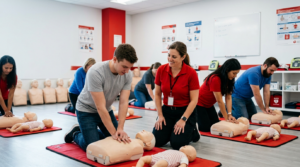
Hybrid model built for busy EMTs: Complete the online portion of the BLS course on your own time — at home, at the station, between shifts. Then book an in-person skills session at any SureFire CPR location. Skills sessions run hourly, 24 hours a day, 7 days a week, including nights and weekends.
20–45 minute skills sessions: The in-person component takes less than an hour. You train on an AHA Live Feedback Manikin that provides real-time data on compression rate, depth, and technique — meeting AHA standards objectively, not just instructor opinion.
AHA BLS eCard issued the same day: The moment your skills session is complete, your official AHA eCard is sent to your email. You can submit it to your LEMSA immediately. No processing delay. No waiting for a physical card in the mail.
Stack BLS + ACLS + PALS in one visit: If you’re also maintaining ACLS or PALS certifications alongside your EMT renewal, SureFire CPR can run back-to-back skills sessions the same day. BLS can be added to any ACLS or PALS class for an additional $50.
SureFire CPR locations across Southern California include Orange, Irvine, Laguna Hills, Garden Grove, Downtown LA, Burbank, Long Beach, Riverside, Corona, Moreno Valley, and North Park in San Diego. Most offer 24/7 access — including a secure building entry code for after-hours visits.
Find Your Nearest Southern California Location
EMT Renewal Checklist: What to Gather Before You Submit
Use this as a working checklist before submitting to your LEMSA:
- 24 hours of CAPCE- or EMSA-approved CE (or approved 24-hour refresher course)
- CE documentation includes naloxone, epinephrine auto-injector, and glucometer training (unless you hold a current CA paramedic license or AEMT certificate)
- Completed EMSA-SCV (01-17) Skills Competency Verification Form with original signatures from a qualifying verifier
- Current AHA BLS Provider card (or other LEMSA-approved CPR card) from a course with a hands-on skills component — not expired
- Copy of your current (or recently expired) California EMT certificate
- Government-issued photo ID (driver’s license, state ID, or passport)
- LEMSA renewal application, completed and signed
- Renewal fee (check your county’s current fee schedule — fees vary by LEMSA)
- Submit at least 30 days before expiration
Frequently Asked Questions (FAQs)
Where do I submit my California EMT renewal application?
All California EMT renewal applications are processed through your certifying LEMSA — the Local EMS Agency for the county where you hold your certification. There is no online renewal process at the state EMSA level. Contact your county EMS agency directly for their specific forms, fees, and submission instructions.
Do I need to maintain my NREMT to renew my California EMT certification?
No. Once you hold an active California EMT certification, you are not required to maintain NREMT registration for routine renewal. However, if your California certification lapses for 12 or more months and your NREMT has also expired, you will need to pass the NREMT cognitive and psychomotor exams to reinstate your California certification.
What kind of CPR card does California require for EMT renewal?
California requires a current CPR certification at the Healthcare Provider or Professional Rescuer level from a program approved by your LEMSA. Most counties specifically accept or require the AHA BLS Provider card. Fully online CPR certifications without a hands-on skills component are not accepted.
Can I renew my EMT certification if my card is already expired?
Yes, but the requirements increase based on how long it’s been lapsed. Under 6 months: 24 hours CE plus skills verification. 6–12 months: 36 hours CE plus skills verification. 12 months or more: 48 hours CE, skills verification, background check, and proof of passing the NREMT exams or equivalent.
How early can I submit my EMT renewal application?
Most LEMSAs accept applications up to six months before your expiration date. Submitting early locks in your current expiration date as the new start date for your next two-year cycle — so you don’t lose any certification time. EMSA recommends submitting at least 30 days before expiration to allow time for processing.
How long does California EMT certification last?
California EMT certification is valid for two years, expiring on the last day of the month two years from the effective date of your most recent certification.
Where can I get my AHA BLS Provider card for EMT renewal in Southern California?
SureFire CPR is an official AHA Training Site with locations across Orange County, Los Angeles, the Inland Empire, and San Diego. BLS certifications are available with same-day AHA eCard delivery through a 24/7 hybrid training model.