
Are you preparing for your American Heart Association BLS certification course? With the right prep, you’ll walk into your exam confident and ready to respond in real emergencies. Here’s an updated guide reflecting the AHA’s current guidelines.
What Is BLS Certification?
Basic Life Support (BLS), regulated by the AHA, gives healthcare providers the skills to respond to life-threatening cardiac and respiratory emergencies. It’s required for nurses, doctors, EMTs, dentists, respiratory therapists, and pharmacists, and covers CPR, choking response, and AED usage across adult, pediatric, and infant patients.
What’s New Since the Last Guideline Update
Before you study, know what’s changed. The AHA’s current Guidelines introduced real changes to the material you’ll be tested on:
- A single, universal Chain of Survival replacing the separate adult/pediatric/in-hospital models.
- A new choking sequence — 5 back blows followed by 5 abdominal thrusts, repeated as needed.
- Naloxone administration now built directly into the BLS algorithm for suspected opioid emergencies.
- Renewed focus on visible chest rise during ventilation, avoiding both too little and too much air.
If your last certification predates this update, plan on relearning parts of the algorithm rather than just refreshing what you already know.
8 Tips for BLS Certification Prep
Tip #1: Choose the Right Training Format
SureFire CPR offers a hybrid model — complete the cognitive material online, then verify skills hands-on with an interactive manikin at a nearby Verification Station. This suits healthcare professionals who need flexibility without giving up hands-on competency checks.
Tip #2: Study the Current BLS Guide, Not an Old One
Given the scope of the recent update, make sure any study guide, app, or practice material you’re using has been refreshed — older materials will teach the outdated choking sequence and Chain of Survival model.
Tip #3: Write Down Your Questions in Advance
As you review, jot down anything unclear — especially around the newer naloxone-in-BLS content, which trips up a lot of test-takers seeing it for the first time.
Tip #4: Learn the Key Terms Cold
Compression rate, ventilation, defibrillation, and now naloxone timing — know these terms before class so you can focus on skill-building rather than vocabulary.
Tip #5: Take a Current Practice Exam
Practice exams built on outdated guidelines will give you false confidence. Confirm the practice test you’re using reflects the current update before relying on it.
Tip #6: Prioritize Rest and Hydration Beforehand
Sleep, hydration, and a decent meal before your skills check measurably improve retention and hand-eye coordination during compressions and AED use.
Tip #7: Know What the In-Person Skills Check Actually Involves
This is where most candidates lose points — not the written exam. Understanding the format ahead of time removes a big source of exam anxiety (see FAQ below).
Tip #8: Study With a Peer or Group
Reviewing the updated algorithm with a colleague, especially one also relearning the new choking protocol, reinforces retention through discussion.
Get Certified With SureFire CPR
Ready to put these tips into practice? SureFire CPR’s BLS courses are built around the current AHA guidelines, with a hybrid format designed for working healthcare professionals.
FAQs
How many questions are on the BLS certification exam?
Typically around 25 multiple-choice questions plus a hands-on skills assessment.
What happens during the in-person BLS skills verification?
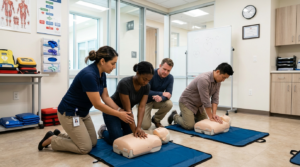
You’ll demonstrate high-quality compressions, ventilation technique, and AED use on an interactive manikin in front of a certified evaluator. This is the part your study prep should target most, since it’s where most candidates lose points — not the written exam.
Are there 24/7 locations to complete my BLS skills check after finishing the online portion?
Yes — look for a provider offering Verification Stations with flexible, self-scheduled hours rather than fixed classroom times, so you’re not stuck waiting for the next class slot.
What happens if I fail my BLS exam?
Most programs, including SureFire CPR, allow one retake of the written exam.
How long is BLS certification valid?
Two years from the date of certification.
What's different about the exam since the recent AHA update?
Expect questions on the unified Chain of Survival, the 5-back-blows/5-abdominal-thrusts choking sequence, and naloxone placement within the BLS algorithm — content that didn’t exist in older courses.
How long does a BLS class typically last?
Roughly 3–4 hours for initial certification through SureFire CPR’s hybrid format.